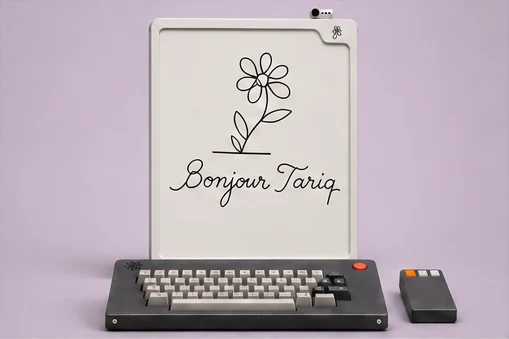
Buroviseur 2.0
A machine ahead of its time, forgotten, its prototypes lost or destroyed, and now reimagined, almost 50 years later.
Full Circle
There was a time when people thought seriously about the future of the office. At Xerox PARC, in California, that thinking gave us the Alto. In Switzerland, at ETH Zurich, Niklaus Wirth's team built the Lilith. In the United Kingdom, ICL took up the PERQ. In France, at Inria, a talented team of engineers designed the Buroviseur.
All were pioneering machines, conceived far too early. They were built for thinking in an age of artificial intelligence that had not yet arrived.
Now that AI and autonomous agents are here, we deserve a workspace designed to help people think, shaped by a different vision from the one the market is offering. So we imagined a Buroviseur 2.0.
The Buroviseur
The Buroviseur was connected to Cyclades, the network Louis Pouzin built in France. It was an Internet before the Internet, years ahead of its time, and it should have become the backbone of a French Internet. Valéry Giscard d'Estaing's government shut it down to push centralised telematics networks instead.
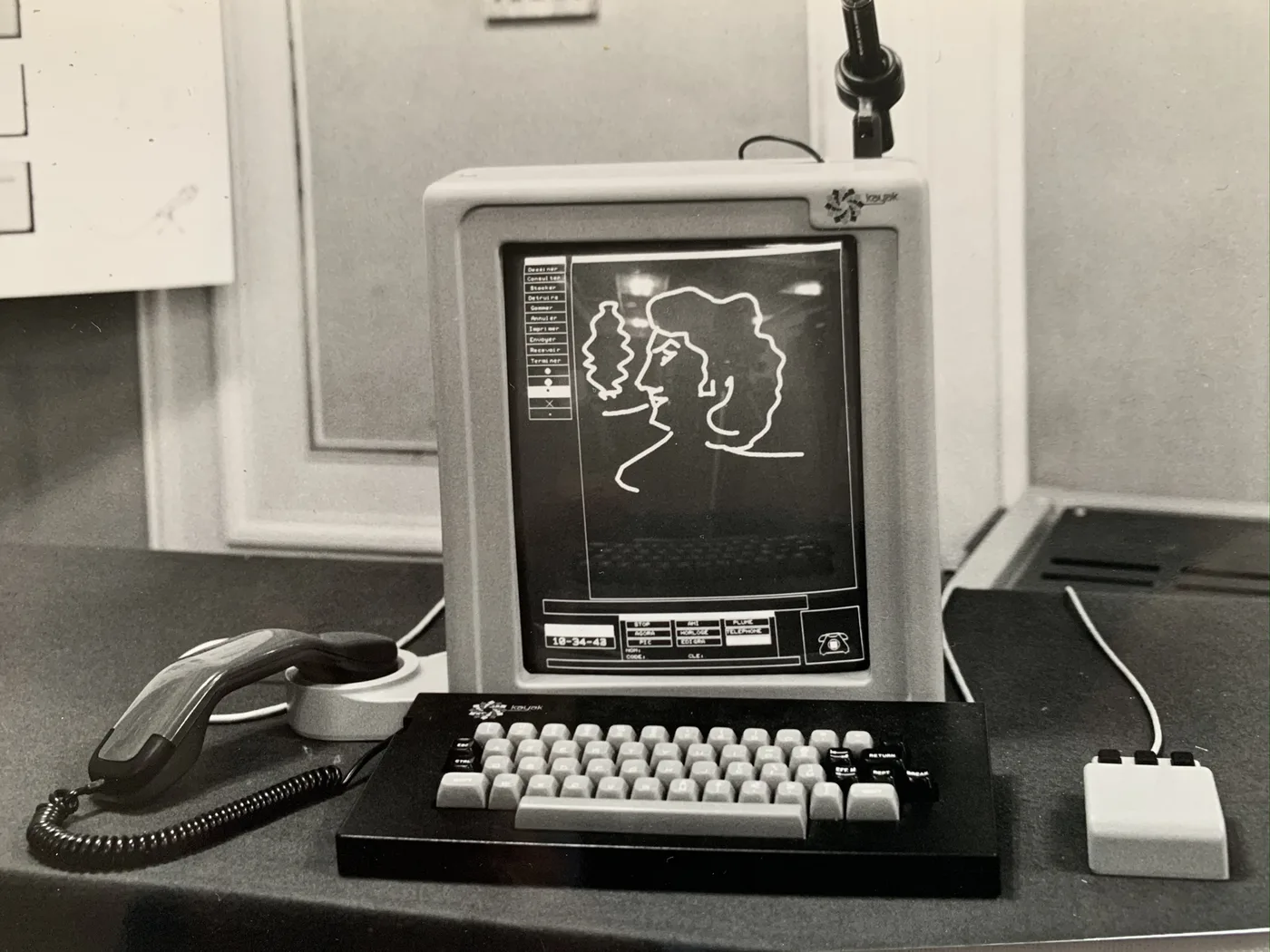
Najah Naffah's team designed the workstation at Inria, in Rocquencourt, and unveiled it in 1981. It had a graphical display, a mouse, windows, voice and the telephone.
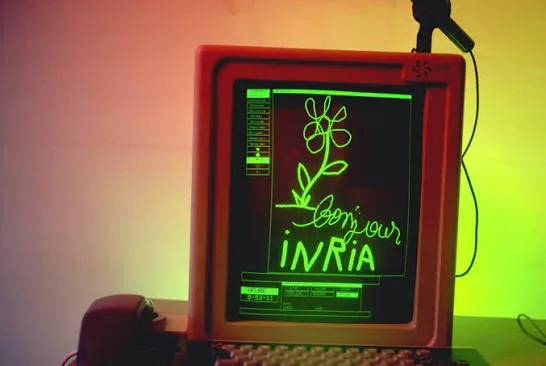

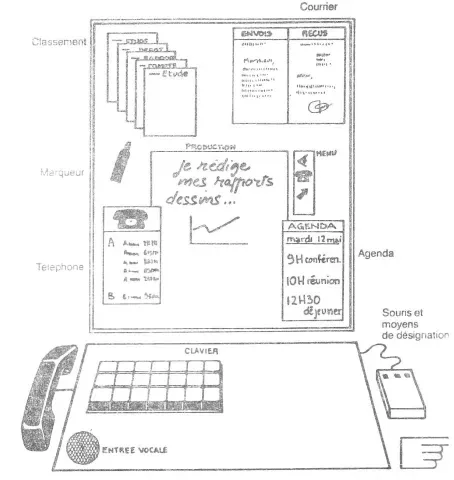
The team also wrote all of its software. VITRAIL managed the windows on screen, and each application had its own: AGORA for mail, VISION for archiving, BOTTIN and IGLOO for the directory, AGENDA for the calendar and PLUME for documents. They all followed the same conventions.
The Buroviseur is proof that France once had ideas at least as intellectually ambitious as the Alto in the United States or the Lilith in Switzerland.
That vision did not survive the French bureaucratic machine. The project was abandoned, and the last remaining units, stored at Bull, were probably all destroyed.
Meet the team
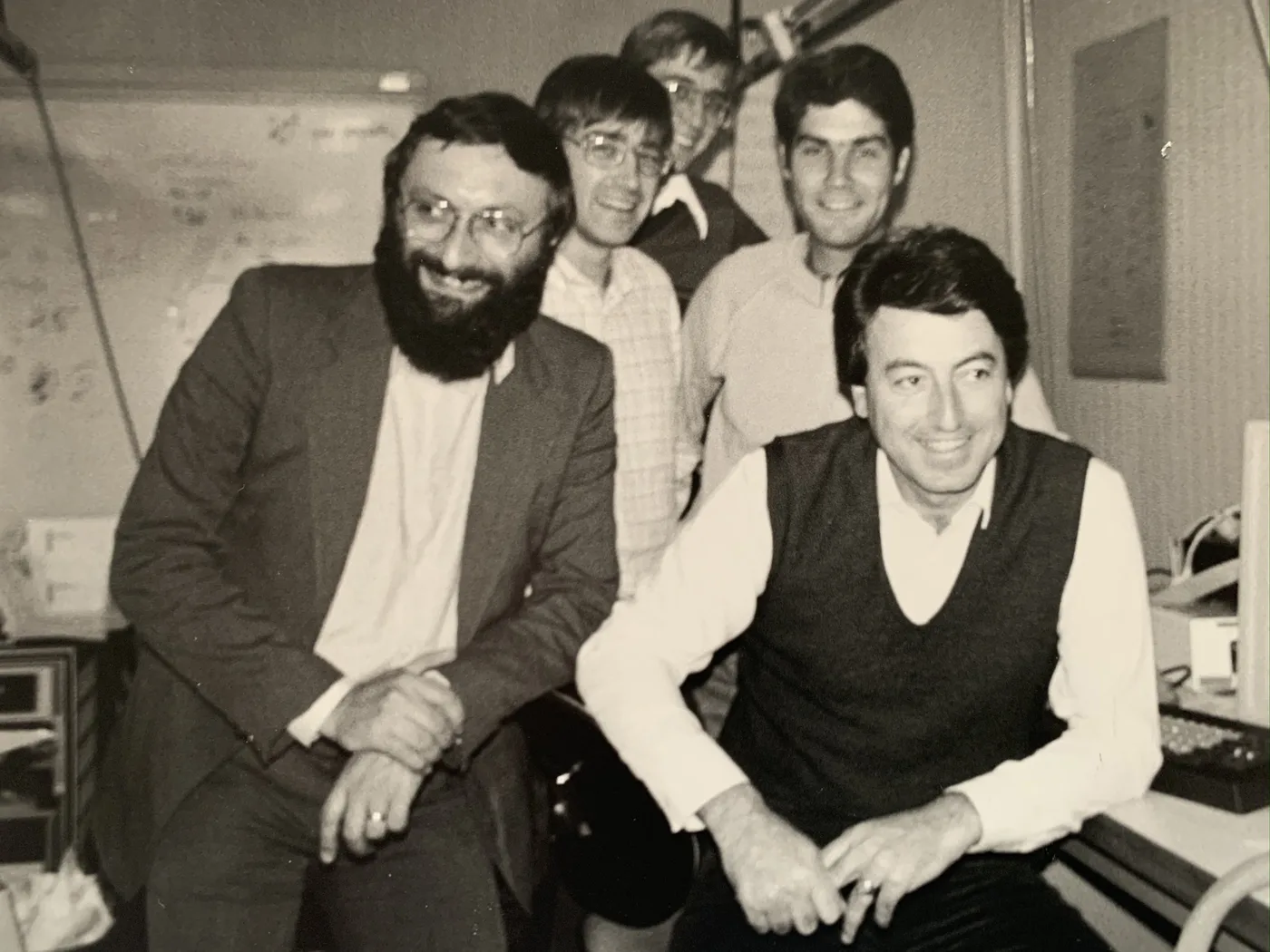
The Buroviseur was designed at Inria, in Rocquencourt, by Najah Naffah's team.
In his paper on LEA, Najah Naffah names the members of the Kayak team he worked with: Mazoyer, Largillière, Scheurer, Berber, Wegmann, Karmouch and Sztajnkrycer. VITRAIL and RASTER-OP owe much to D. Berber, A. Wegmann and B. Mazoyer. He also credits the pioneering work done at Xerox PARC.
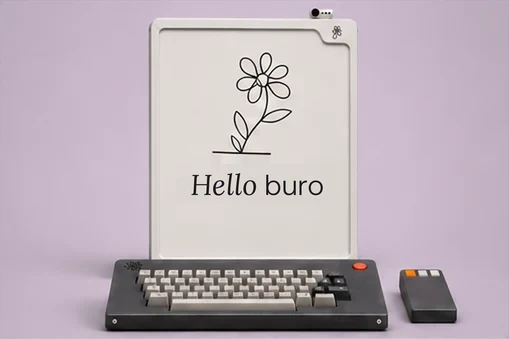
Hello BUROviseur 2.0
The workstation prototype
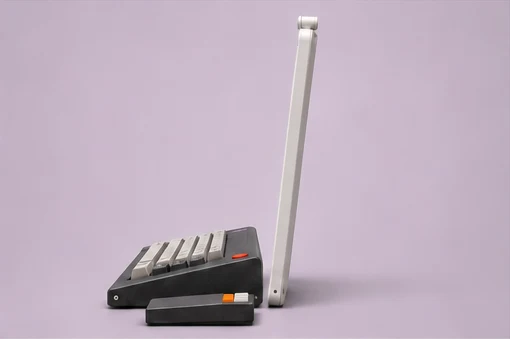
The display will be electronic paper, shaped like a page. A small camera and a microphone let you sketch and dictate.
The keyboard brings back the tall keys of the original. The mouse keeps the three buttons of the Kayak design, with an orange button to speak to the machine.
The operating system is currently being rethought entirely.
Early design specs
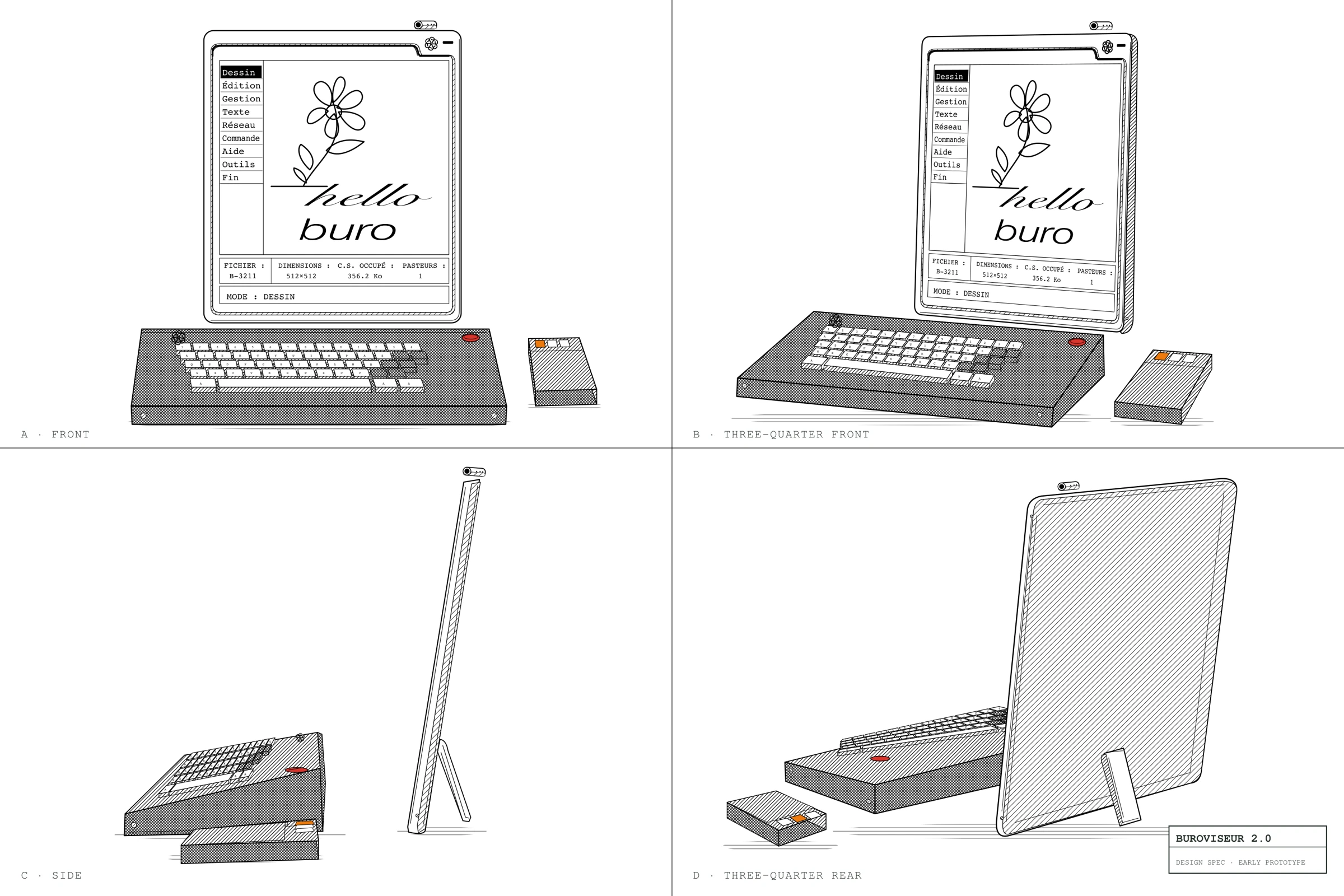
All we had to work from were a few pages of documentation and a handful of photographs.
We are working on an open source, open design, connected, new personal agentic computer.
Our goal is to build something that any school, any office and anyone who wants to think, and to have access to something different, can use. It will connect to the entire agentic ecosystem envisioned by Tariq Krim and his team at Human Intention.
The French
Alto
When France could materialize a vision of the future.
How France was part of the race to create a machine to do your best work. Here is a mostly unknown story.
In 1981, in Rocquencourt, a team at Inria unveiled one of Europe's first bitmap workstations: the Buroviseur.
Machines
to think.
In 1962, Douglas Engelbart published "Augmenting Human Intellect". For him, the computer was meant to augment human intelligence, not to automate it. On December 9, 1968, in San Francisco, he and his team showed the NLS system in public: the mouse, on-screen text editing, hypertext, several people working on the same document, and video conferencing.
Over the next fifteen years, a handful of laboratories in the United States, Switzerland and France built personal workstations on these ideas: a graphical screen, a mouse, a network.
- 1968SRI, Menlo Park
NLS
Douglas Engelbart and the Augmentation Research Center showed the mouse, hypertext and shared work.
- 1971IRIA
Cyclades
Louis Pouzin started the Cyclades network. First demonstrated in November 1973. He invented the datagram there.
- 1973Xerox PARC, Palo Alto
The Alto
Bitmap screen, three-button mouse, windows, Ethernet. It was never sold.
- 1974EPFL, Lausanne
Nicoud's mouse
Jean-Daniel Nicoud developed a mouse with optical encoders and started the Smaky line of computers.
- 1977Xerox PARC
Wirth discovers the Alto
Niklaus Wirth, of ETH Zurich, spent a sabbatical at PARC. Xerox would not let him take one home.
- 1978Xerox PARC
Pouzin and Naffah's trip
Louis Pouzin and Najah Naffah visited the American laboratories and discovered the Alto and Ethernet.
- 1979IRIA, Rocquencourt
The Kayak project
The Kayak project began, as a continuation of Cyclades.
- 1979Three Rivers, Pittsburgh
The PERQ
Designed by Carnegie Mellon alumni, inspired by the Alto, later built and sold in Europe with Britain's ICL.
- 1980ETH Zurich
The Lilith
Full-page portrait screen, mouse, network, all of its software written in Modula-2. About 120 units.
- 1981Inria, Rocquencourt
The Buroviseur
The French Alto. Its three-button mouse was designed with Jean-Daniel Nicoud, of EPFL.
- 1981Xerox
The Star 8010
The commercial version of the Alto's ideas. It influenced Apple, Microsoft and Sun.
Louis Pouzin
and Cyclades.
Before the Buroviseur, there was Cyclades. At IRIA, Louis Pouzin led this experimental network, first demonstrated in November 1973. There he invented the datagram: each packet travels on its own, and it is up to the machines at each end to make sure everything arrives. This principle became one of the foundations of the Internet.
In 1972, Louis Pouzin was one of the founders of the International Network Working Group, alongside the American pioneers of ARPANET. The Buroviseur grew out of Cyclades.
The first
Buroviseur.
At INRIA, through the Kayak project, Najah Naffah's team imagined an office where a document could move from drafting to mail, then to filing. The mouse and the voice gave access to every service from a single workstation.
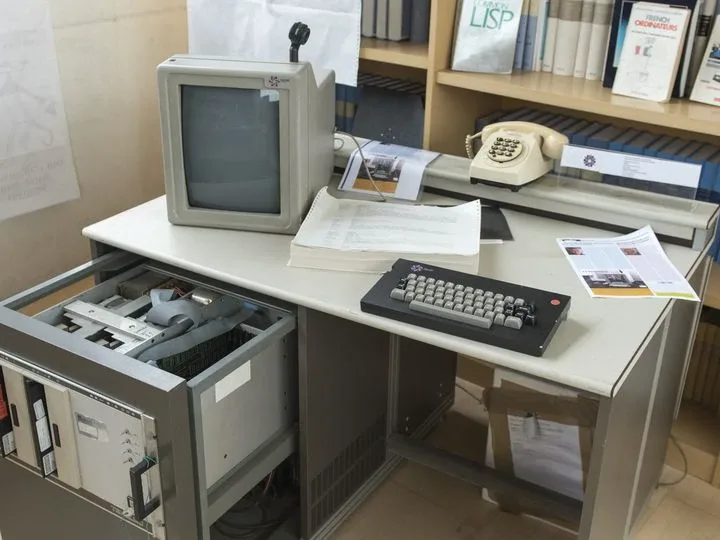
The office
of the future.
Najah Naffah was a researcher on the Cyclades team, working on the pioneering network Louis Pouzin built in France before the Internet. Some of the Internet's future protocols grew out of that work.
In the summer of 1978, Louis Pouzin and Najah Naffah toured the major American labs, Xerox PARC among them. There they saw the Alto and the Ethernet network. In 1979, IRIA, later renamed INRIA, launched the Kayak pilot project as a follow-on to Cyclades. Within two years, Kayak would build a French equivalent of the Alto.
The
machine.
One of Europe's first bitmap workstations: a graphical display, an AZERTY keyboard and a three-button mouse designed with Jean-Daniel Nicoud of EPFL.
It could speak and listen, with speech synthesis and recognition of a few hundred words. It dialled phone numbers straight from the directory and the calendar. Through an X.25 gateway, it gave access to Minitel services.
In March 1981, the first major demonstration brought six networked machines together.
An office,
not a set of programs.
Under VITRAIL, the Buroviseur's window manager, each application had its own window, and they all followed the same conventions. Najah Naffah described their shared interaction language, LEA.
AGORA VISION BOTTIN
AGENDA PLUME
Touch the box to pull out the disk.
- AGORA
- Electronic mail.
- VISION
- Archiving and document search.
- BOTTIN
- The directory.
- IGLOO
- The name server, with BOTTIN.
- AGENDA
- The time, the date, things to do.
- PLUME
- Document production.
Built for
the network.
The Buroviseur was never on its own. Workstations and servers shared a coaxial cable, the Danube local network, built on the same principle as Ethernet.
Beyond the office, it was linked to public networks: Cyclades, X.25 and Minitel. In 1981, it was a networked workstation, not a computer sitting on a desk.
The silent
disappearance.
The machine worked, but the next step never came: industrialisation. At the end of 1983, Bull took an interest, and part of the team joined it in early 1984. The Buroviseur gave rise to the MultiWorks and MultiCard projects, and PLUME to Balzac and Raphaël.
With no one to take it further, the Buroviseur was gradually forgotten. Not a single unit survives: the last ones, stored at Bull, were probably all destroyed. All that remains are photographs, films and a few articles.
- 1979The Kayak project starts at IRIA.
- 1981First demonstration of the Buroviseur.
- 1983The project ends, agreement with Bull.
- TodayThe last units, stored at Bull, were probably all destroyed.
The original system
The Kayak team did not write separate programs for the Buroviseur. They built a set of services that live on the same workstation and follow the same rules. Najah Naffah describes them in his paper on LEA, the language that ties them together. This page draws on that paper and its original figures.
The services
The Buroviseur brings mail, filing, the directory, the calendar, writing, printing, the telephone and access to other computers together on one workstation. Each service has its own information space, made of electronic documents.
| Service | What it does | Command |
|---|---|---|
| AGORA | Distributed electronic mail and teleconferencing. Send, reply, forward, or circulate a message along a set route. | Envoyer |
| VISION | Filing, archiving and retrieving documents, in "drawers" and in private or shared databases. Search by terms, or by browsing the tree of folders. | Classer |
| BOTTIN · IGLOO | The member directory and the name server. | Modifier |
| AGENDA | The time, the date and things to do. | Remplir |
| PLUME | Document production, in free format (a blank page) or fixed format (document templates). | direct |
| IMPRIMANTE | Printing, with page, line and font templates. | direct |
| EMULATION | The workstation behaves like another terminal (teletype, videotex, 2741 or 3270) to reach data processing and telematics services. | direct |
| TELEPHONE · ATELO | Call management: dial a number now or later, and be told when a call comes in. | direct |
| PROFESSIONAL APPLICATIONS | Calculation, for example with VisiCalc. | direct |
The service zone
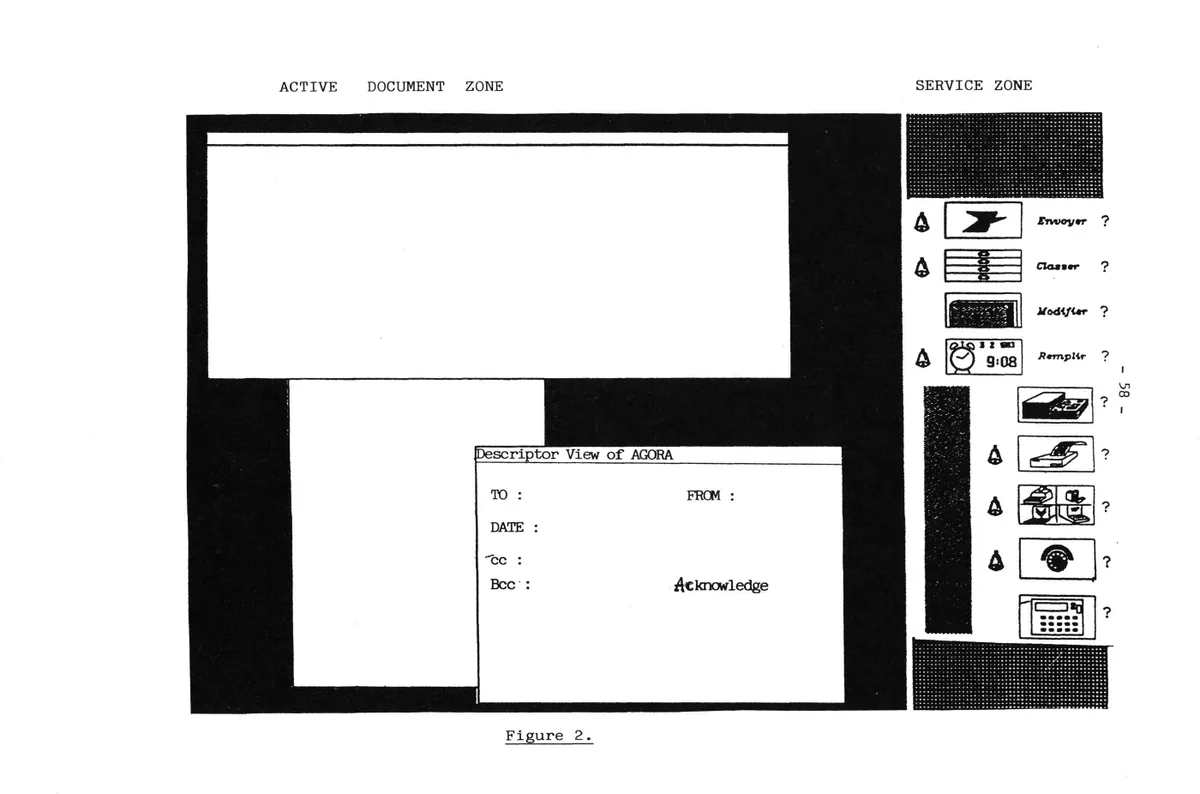
A fixed part of the screen is set aside for the services. Each one has its symbol, its main command and a question mark. Pointing at the symbol with the mouse opens the service's space: the AGORA mailbox, the VISION drawers, the day in the calendar. Pointing at the command starts the action straight away.
A small bell, the signal, is attached to the services that wait for an event: a message arriving, a filed document due on a given date, a finished printout, a call. When the event happens, the bell moves, or rings through speech synthesis.
The question mark opens help and status for each service: the members of a mailing list in AGORA, free disk space in VISION, the document types in PLUME.
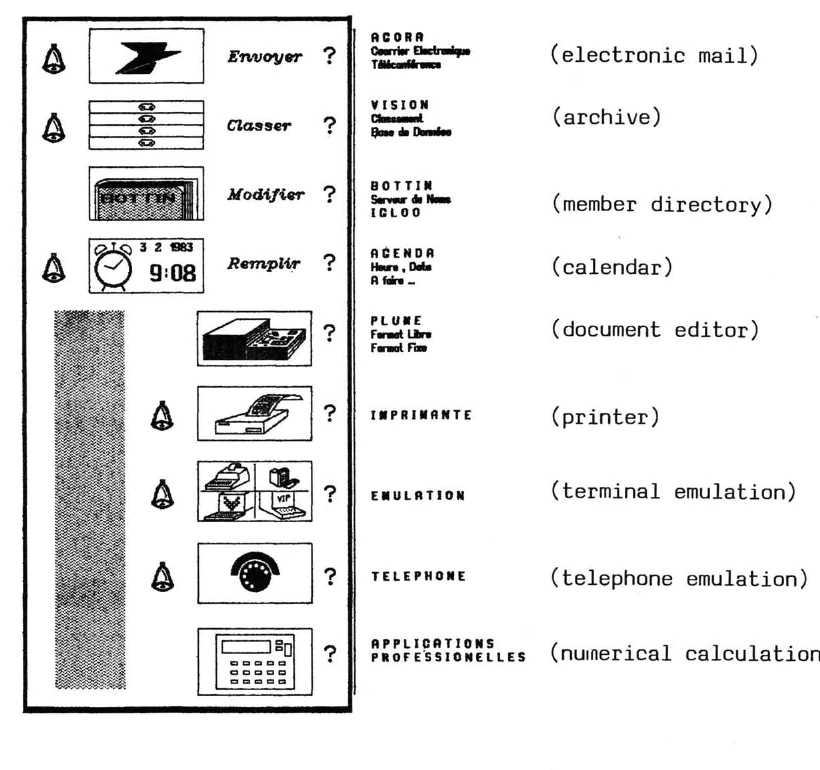
LEA, one way to talk to every service
LEA stands for Langage d'Exécution inter-Applications. The starting idea is simple: users should not have to relearn each program. Whatever the service, they point at menus with the mouse, fill in fields, and find the same gestures everywhere. LEA also lets the services pass documents to one another.
The common commands, available in every service:
- COPYCopy a whole document, or just a paragraph or a drawing, into another document. The copied object is given a name and becomes a document in its own right.
- MOVEPut an object somewhere else, keeping its name.
- DELETERemove an object from the screen without destroying it in the files.
- STOP · RESUMEPause a command and pick it up later, without losing anything.
- CANCELStop a command in progress.
Every action follows the same rule:
- Choose the service's symbol.
- If it is a direct action, go to step 4.
- Point to the object and, if needed, mark where it starts and ends.
- If all parameters are known, go to step 6.
- Fill in the descriptor window.
- Confirm or cancel with the right-hand mouse button.
At start-up, users enter their name and password. They can also use a spoken password, on its own or on top of the written one.
The screen
The screen is split between the active document zone on the left and the service zone on the right. A document appears either by its name alone (reduced) or with the contents of one page (visible).
When a command needs more detail, a descriptor window appears, always in the same place. To send a message, it is the message header. To read mail, it is a set of criteria: sender, date, subject. In VISION, it is a search by terms or a walk through the tree of documents.
VITRAIL, the window manager
VITRAIL shows one window for each open application. Windows can overlap, as the user chooses. VITRAIL keeps the contents of each one and redraws whatever was hidden when a window moves. Any window can be reduced to its name alone, which matters on a screen of limited size.
Scroll bars surround each window and let you move in all four directions. An application can open several windows, for example to browse a folder of documents.
Underneath VITRAIL, RASTER-OP does the basic work: logical operations between two rectangles of pixels of the same size, sometimes combined with a pattern. VITRAIL and every application rely on it to draw on the screen.
The machine
The drawing of the electronic office shows the overall idea: filing, mail, document production, the calendar and the telephone around one workstation, with the mouse, pointing devices and voice input. The block diagram shows how the workstation's hardware is organised.
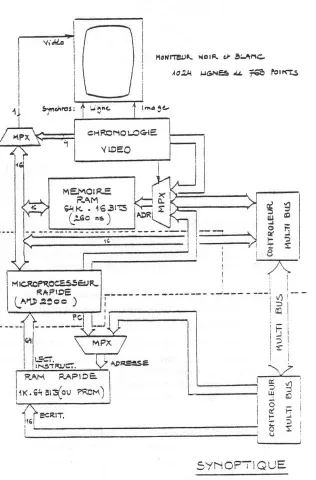
The team
Najah Naffah names the members of the Kayak team he worked with: Mazoyer, Largillière, Scheurer, Berber, Wegmann, Karmouch and Sztajnkrycer. VITRAIL and RASTER-OP owe much to D. Berber, A. Wegmann and B. Mazoyer. He also credits the pioneering work done at Xerox PARC.
Source: Najah Naffah, "LEA: a language for multiapplication interaction on the Buroviseur", Inria, Le Chesnay, around 1983. English translation by Reinhard Kofer, Siemens.
We are thinking about a new version of this system.
About
An afternoon idea turned into a full workable concept.
It started one afternoon, as an artistic project.
A living archive and memory
Since the early 80s, as a kid, Tariq Krim has collected books, magazines, manuals and computers, and has maintained a living archive and memory of the early Internet, cyberculture and computing.
He has also been passionate about the early European computing culture. In many ways it was very different, and it had nothing to be ashamed of next to its American counterpart.
It has unfortunately totally disappeared from the official European narrative in technology today.
From the Alto to the Buroviseur
He has a special passion for early graphical user interfaces: how a group of people scattered around the world figured out a way to make computers easier, and accessible to everybody.
In the mid-80s he discovered the existence of Xerox PARC and its machine, the Alto.
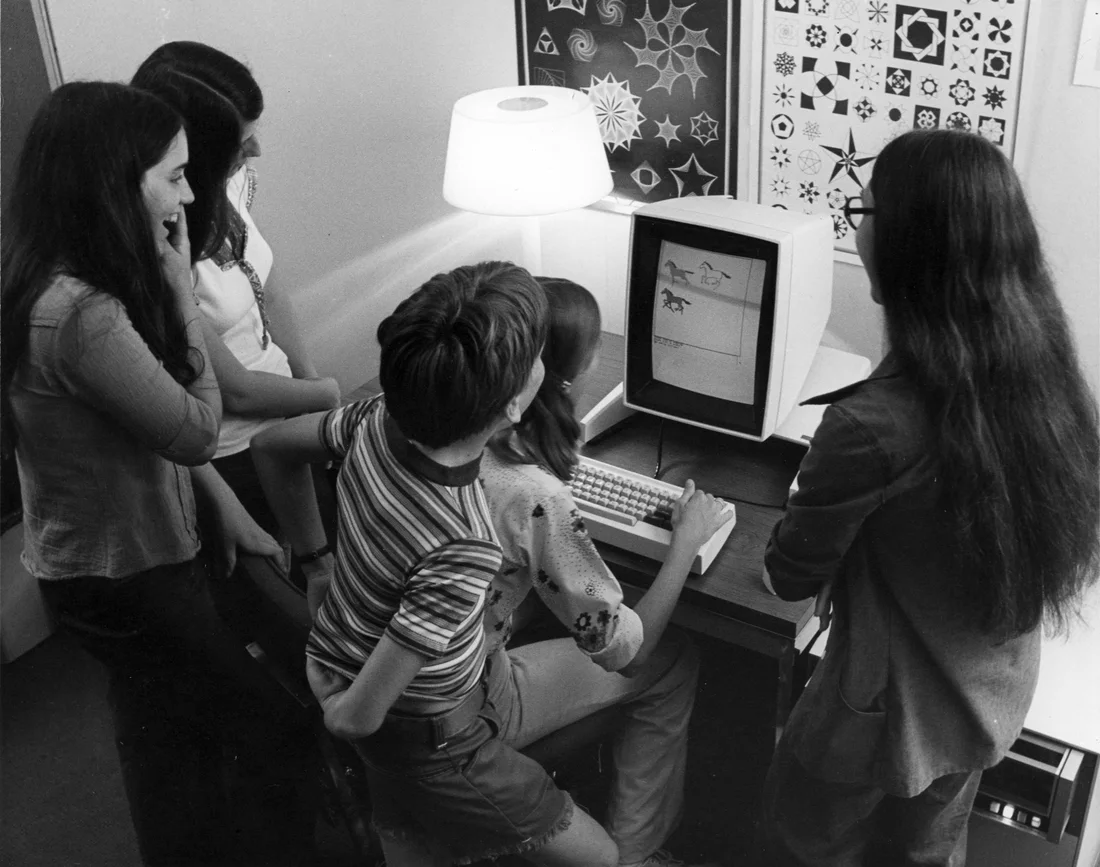
Through friends of his father, he learned that other countries had worked on the same idea, including France, Switzerland and the UK: a computer that is easy for anyone to work with.
That is how he first heard of a French project. It was never released. He did not have its name, and had no access to any picture of it.
It was only years later that he made the connection with the Buroviseur.
A conversation with Louis Pouzin
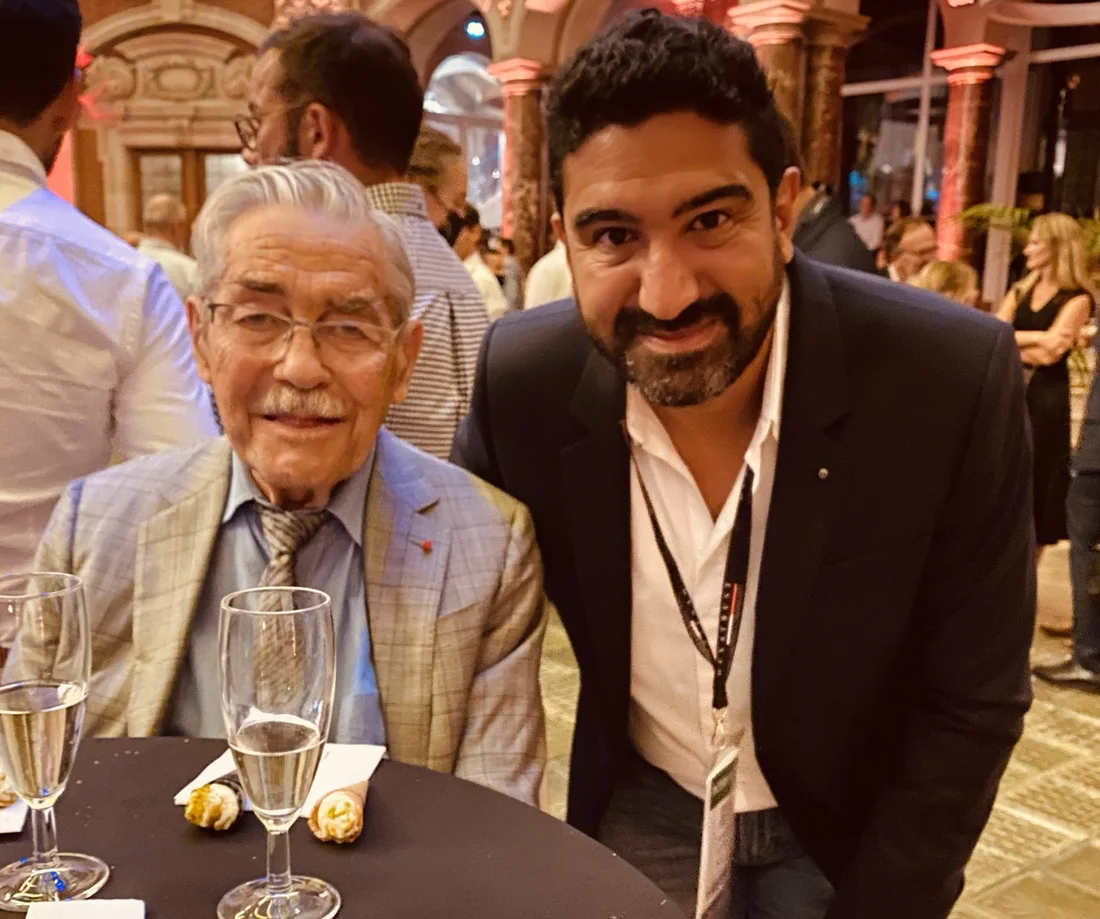
The only conversation he ever had about the Buroviseur was a few years ago in Lille: a long talk with Louis Pouzin.
He has met Louis Pouzin many times, and has always had an incredible admiration for him.
He considers him one of the best software and computer engineers of all time, and one of the real pioneers of the Internet.
He asked him about the shell, then about the Buroviseur.
The conversation was scattered: the place was very noisy, and Louis Pouzin's hearing was not as good as before.
It was a wonderful conversation all the same. They ended up talking about what it is to build the future in a country that is not always welcoming to those who want to build it.
Lost computers
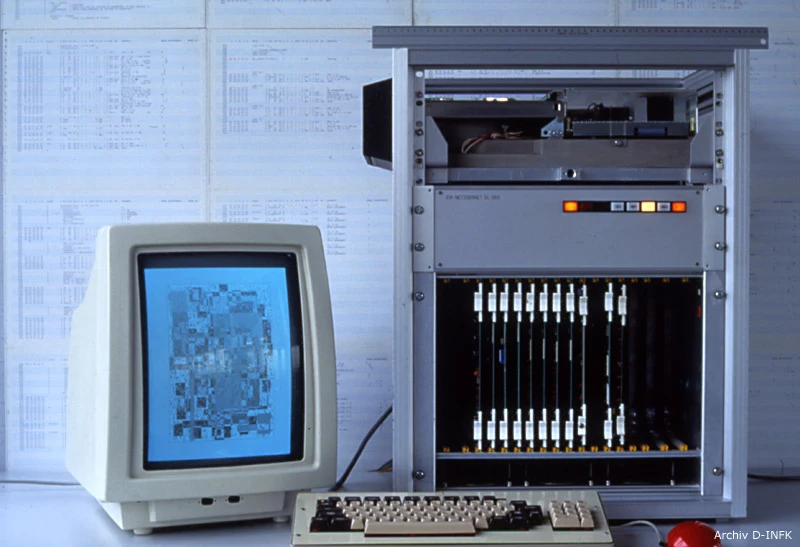
Years later came the passing of Niklaus Wirth, the creator of Pascal, Modula and the Lilith.
It left him attached to one idea: revisiting the history of these lost computers.
The agentic computer
In the age of AI, prototyping has become easy.
So Tariq wondered whether there was an opportunity to give a body to what will soon become the agentic computer: the set of tools that lets us do our tasks, with large language models for thinking and agents for doing.
Then he found an old picture of the Buroviseur and of the team behind it.
The machine felt ahead of its time for one reason: it had voice access.
Something that seemed completely unlikely to work in the late 70s is now the default way to interact with a computer.
A sketch in a café
On a sunny day, in a café in the 4th arrondissement of Paris, he drafted a few ideas of how such a concept could be reimagined.
Months later he found the draft, took a photo of it and sent it to one of his AIs.
It came back with an early prototype of how it could look.
Tariq had been working for months on Human Intention, a design lab at the frontier that lets people use AI to do their best human work.
The question came naturally: is there a computer that works with it?
Building a computer today vs 2008
Tariq Krim's second international startup was Jolicloud, created with Romain Huet.
It produced the first computer whose operating system was fully connected to the cloud and used a web interface.
It was also the first sovereign computer to come out of Europe in decades, with an operating system years ahead of the Google Chromebook in simplicity and integration.
Back then, everything had to go through securing production in Taiwan and China, and through long conversations on how things could be made.
Today, basically, anyone can build a computer. You just need an open source chip, a screen, a microphone and a connection to the Internet.
Even an AI can design and assemble the PCB. Most screens, chips and components are off the shelf, shipped to you in 48 hours.
And a computer can expand with other devices: you can carry a mini tablet that holds all the data and content you want.
This is the new challenge: building a product that can become the physical interface between humans and AI.
A homage to the pioneers
The Buroviseur 2.0 is also a homage to the people who carried the original vision and never got the credit they deserve, or rather any credit at all.
The documents and photos are sparse, and none of the computers is known to have been preserved.
It also shows how little technology pioneers are considered in France, a feeling Tariq shares with the founders of the Buroviseur.
A forgotten machine, a living archive, a sketch in a café, and AI that makes prototyping easy: put together, the Buroviseur 2.0 became the obvious thing to build.
About Tariq Krim
Tariq Krim is the founder of Netvibes, Jolicloud and Cybernetica. He is the author of the Slow Web Manifesto and one of Europe's early pioneers of human-to-web, and now human-to-AI, interfaces. He runs the frontier design lab Human Intention and the agentic creative studio Earth is a Beta Test.
The most up-to-date information is on his website. You can read him every week on Cybernetica.